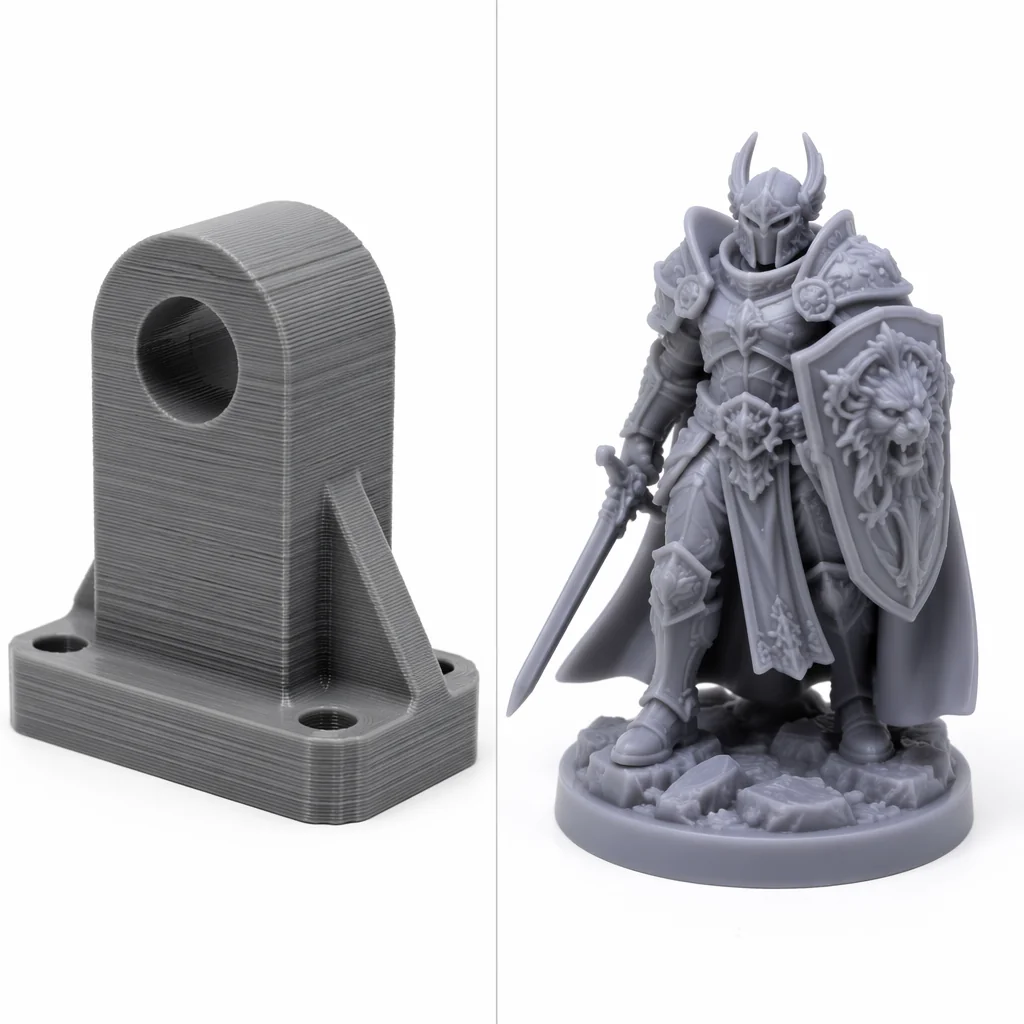
Choosing the right 3D printing technology is one of the most critical decisions for businesses adopting additive manufacturing. The two most common desktop technologies—Fused Deposition Modeling (FDM) and Stereolithography (SLA)—offer very different capabilities, and understanding their strengths and limitations is essential for making the right investment.
How Each Technology Works
FDM (Fused Deposition Modeling)
FDM printers build parts by extruding thermoplastic filament through a heated nozzle. The material is deposited layer by layer on a build platform, with each layer bonding to the previous one as it cools. This is the most widely used 3D printing technology, known for its simplicity, material versatility, and cost-effectiveness.
SLA (Stereolithography)
SLA printers use a UV laser (or LCD screen in modern DLP/MSLA variants) to cure liquid photopolymer resin into solid parts. The build platform lowers into a resin vat, and the light source traces each layer, solidifying the resin with exceptional precision. SLA produces the smoothest surface finish and finest details of any desktop 3D printing technology.
Key Comparison Factors
| Factor | FDM | SLA |
|---|---|---|
| Layer Resolution | 50-400 microns | 25-100 microns |
| Dimensional Accuracy | ±0.5% (±0.15mm) | ±0.2% (±0.05mm) |
| Surface Finish | Visible layer lines | Smooth, detailed |
| Materials | PLA, ABS, PETG, Nylon, TPU | Standard, Tough, Flexible, Castable resins |
| Mechanical Properties | Strong, functional | Brittle (standard), varies by resin |
| Post-Processing | Support removal, sanding | Washing, curing, support removal |
| Cost per Part | $ - $$ | $$ - $$$ |
| Best For | Functional prototypes, tooling | Visual models, jewelry, dental |
When to Choose FDM
FDM is the right choice when you need:
- Functional prototypes that will be tested under real-world conditions
- Large parts — FDM printers typically offer larger build volumes at lower cost
- Engineering materials like ABS, PETG, or Nylon with specific mechanical properties
- Cost-effective production for iterative design cycles
- Simple operation with minimal post-processing requirements
When to Choose SLA
SLA is the right choice when you need:
- High detail and smooth surfaces for visual prototypes or presentation models
- Fine features like small text, intricate patterns, or thin walls
- Jewelry or dental applications requiring castable patterns
- Tight tolerances for parts that must fit together precisely
- Miniatures and figurines with exceptional surface quality
Key Takeaways
- FDM excels at functional parts with good mechanical properties and is ideal for prototyping and tooling.
- SLA delivers superior surface finish and detail, perfect for visual models, jewelry, and dental applications.
- Consider your primary use case: functional testing favors FDM; aesthetic quality favors SLA.
- Many businesses benefit from owning both technologies to cover the full spectrum of applications.
Making the Decision
The best way to decide is to consider your specific requirements:
- What is the primary purpose of your printed parts? (Functional testing, visual presentation, casting patterns?)
- What level of detail do you need? (Visible layer lines acceptable, or smooth finish required?)
- What materials do you need? (Standard thermoplastics, or specialized resins?)
- What is your budget for both equipment and ongoing material costs?
- How much post-processing time can you allocate?
If you're still unsure, our team of application engineers can help evaluate your specific needs and recommend the optimal technology and printer model. Contact us for a personalized consultation.